This is a bi-lingual blog of the members of the ADAMIS team at Laboratoire APC and invited guests. We comment on selected papers and events exploring, or relevant to, the interface between physics, cosmology, applied math, statistics, and numerical algorithms and which we have found interesting.

The opinions expressed in this blog reflect those of their authors and neither that of the ADAMIS group as a whole nor of Laboratoire APC.
Showing posts with label CMB polarization. Show all posts

Wednesday, December 22, 2010

First season QUIET observations [1012.3191]

L'expérience QUIET a observé le fond diffus cosmologique entre octobre 2008 et décembre 2010, utilisant un télescope dédié et des récepteurs à 43 et 95 GHz, depuis le désert d'Atacama au Chili (cf. photo ci-contre).
L'article que vous trouverez ici présente les résultats obtenus avec les 19 détecteurs fonctionnant à 43 GHz, d'une sensibilité de 69 uK/sqrt(Hz) pour l'ensemble du plan focal (durée d'observation : 3458 heures).
Le but scientifique de QUIET est la détection des modes B primordiaux, entre l=25 et l=475.
Wednesday, November 24, 2010

The forgotten V

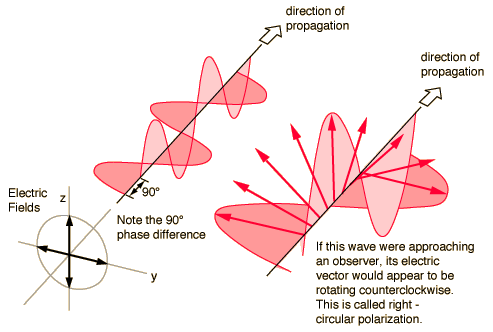
Anybody who ever read a book or some canonical introductory references on CMB polarization has found a small paragraph about the formal definition of the Stokes parameter Q, U, and V. From the combination of the Q and U parameters of the CMB signal it is straightforward to define the well known polarization field P=Q + iU which is now probably the most desired observable in cosmology. The poor V has always been left in the corner and in most of the paper I have ever read up to now is always neglected or claimed to be simply zero. As a (maybe) good student I always found myself thinking “Why is V damped so directly?”.
In the last year a few papers were published providing some further detail about the circular polarization of the CMB i.e. about the so-called V modes.

Tuesday, October 12, 2010

A loopy universe?

During the last decade, much progress have been done in the framework of so-called Loop Quantum Cosmology (LQC). Since the early works of e.g. Bojowald and Ashtekar, aiming at implementating Loop Quantum Gravity (LQG) ideas to the 'reduced case' of cosmology, physicists who embraced this idea are now able to derive non-singular quantum cosmological models and even to predict observational consequences for the B-mode anisotropies of the Cosmic Microwave background (CMB).

Saturday, October 9, 2010

(Lensing) cleaning time !
[arXiv:1010.0048v2]

As mentioned in the post by Josquin elsewhere in this blog, weak lensing has great potential for cosmology and one which we still have to wait to be fully realized. A blessing one might almost think then.

Not always so though ...